
A LETTER FROM KATE
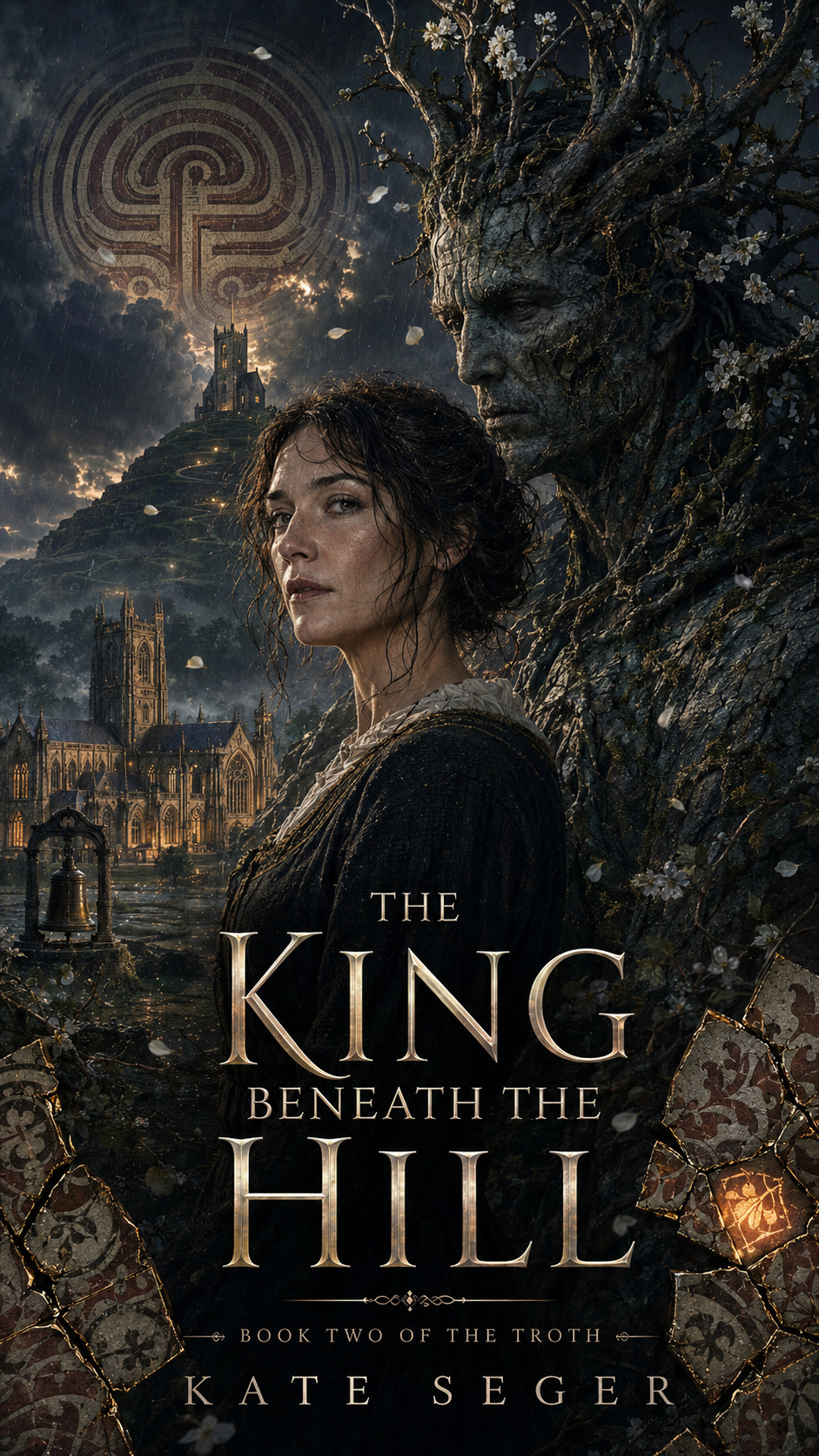
Friends. I promised there would be no preorder. On September 14, The King Beneath the Hill simply appeared. Book Two of The Troth is live.
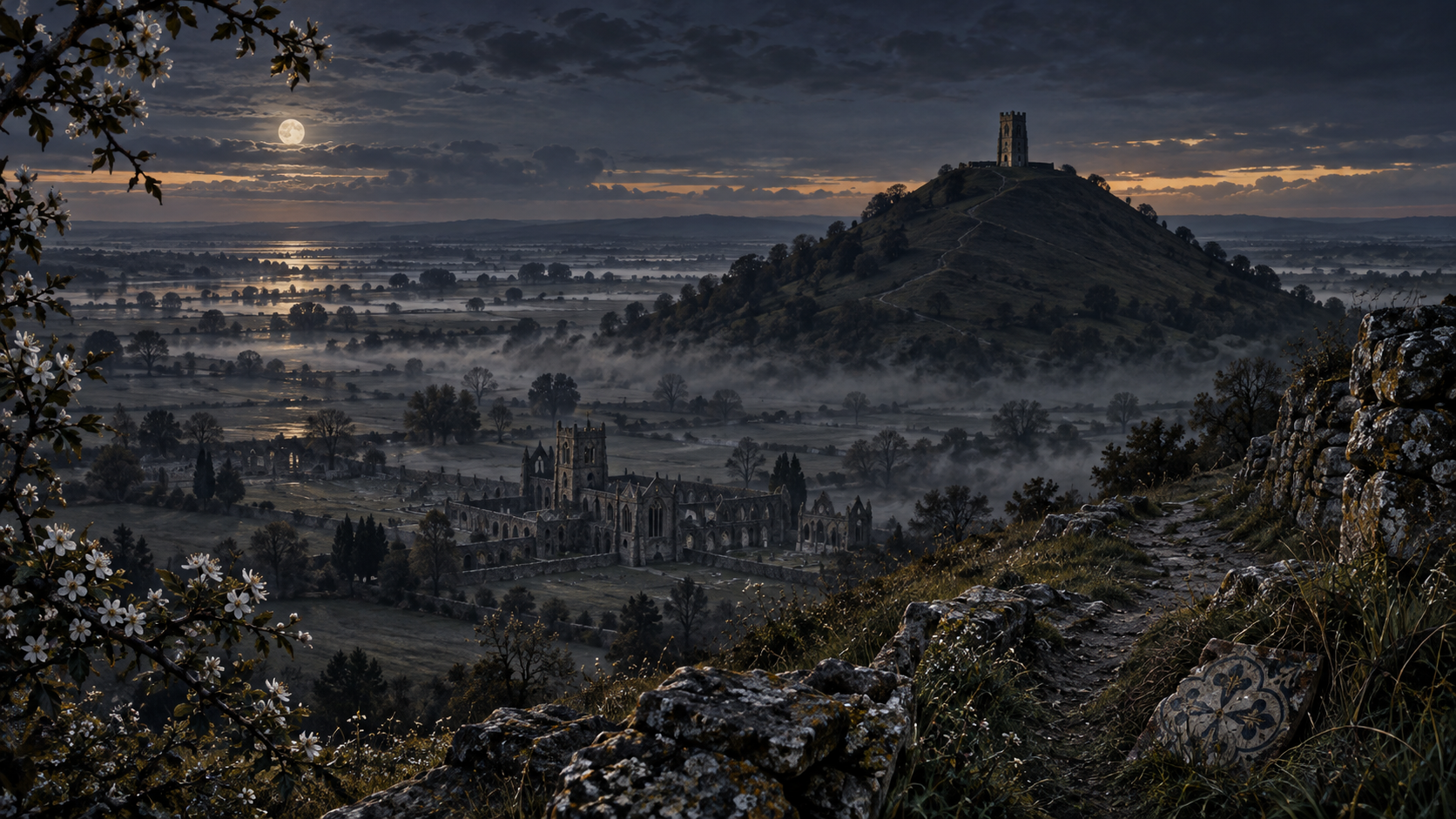
We have left London and 1888 behind. This time it is Glastonbury, 1539, and the abbey's last autumn. Tamsin Hollis, a ceramics conservator, follows a tile into the past and meets Gwyn beneath the Tor. He has held a door closed for two thousand years. The abbey's bells have helped him do it. They will not ring much longer.
Tamsin and Gwyn have their own complete romance. If you have not met Cordelia and Sunder yet, you can begin here.
Before the release, I wrote about the king under the hill: Gwyn ap Nudd, the winter thorn, and the bells. For this letter I went back to Saint Collen's encounter with Gwyn, and to the question of whose story we hear. On the site, there is a second piece about what the real abbey left behind when it closed, including a kitchen that still has its roof.
Thank you, as always, for being here.
— Kate
BONUS CONTENT · FOLKLORE
Gwyn and the Vanishing Court
A closer look at one Glastonbury legend. No spoilers for The King Beneath the Hill.
In my earlier note about the king under the hill, I told you the broad story: Gwyn ap Nudd, the Tor, and the door into the Otherworld. I want to go back to the moment when Saint Collen reaches the top.
In the Welsh Life of Collen, the saint is living as a hermit on Glastonbury Tor. He hears of Gwyn, refuses two summonses, then goes to meet him with holy water. There is a court on the summit: a castle, riders, a company splendid enough to make the bare hill disappear. Collen throws the water. Court and company vanish. The Cambridge study of the Life is a good place to read about the episode and the different traditions folded into it.
That is Collen's account, and the Life is on his side. Elsewhere in Welsh tradition, Gwyn is a ruler of Annwn, the Otherworld. Here he is the dangerous king of a court the saint must refuse. Collen leaves the hill with his victory. The Life never returns to Gwyn.
One surviving manuscript of the Life was copied in 1536, only three years before the dissolution of Glastonbury Abbey. That does not date the beginning of the legend; stories travel for a long time before someone writes them down. But the closeness of those two dates stopped me. While I was setting a novel in 1539, there was this version of Collen's encounter on a page from almost the same moment. The Welsh Classical Dictionary at the National Library of Wales identifies the manuscript.
My Gwyn is a Warden, not a retelling of Gwyn ap Nudd. He has no shining court. He has a door beneath the Tor and two thousand years of duty. Collen's story ends on the hill. In my book, I wanted to stay with the man still standing there.
Sources and further reading
University of Cambridge — Study of the Life of Collen; Welsh Classical Dictionary at the National Library of Wales; National Trust — History and legends of Glastonbury Tor.
BONUS CONTENT · HISTORY
What the Abbey Left Behind
The real Glastonbury behind The King Beneath the Hill. No plot spoilers.
A tile carries Tamsin Hollis into Glastonbury in 1539. She restores ceramics for a living, so I went looking for the material history she might notice. It led me below the abbey floor and, unexpectedly, into the kitchen.
The abbey's last year
Glastonbury Abbey was a working religious house in 1539, not just the ruins we visit now. There had been a major fire in 1184 and centuries of rebuilding afterward. Its church, cloister, kitchens, gardens, and service buildings belonged to people who used them every day. The abbey's history and Historic England's record trace that long use.
In 1539, Henry VIII's government dissolved the monastery. Its last abbot, Richard Whiting, was executed on the Tor. Valuables were taken; the buildings were dismantled over time. Abbey stone went into the town and the causeway toward Wells. Historic England records where its stone went.
What the ground kept
Excavators found a layer of broken stone, glass, mortar, and other debris near the central buildings. In places it is more than a metre deep. It records dismantling on a scale the remaining walls cannot show us. Historic England describes the deposit.
Under the medieval abbey are older churches. Its first stone church, built around AD 700, had a floor made with reused Roman brick and tile. Excavations in the 1920s identified several Saxon phases beneath the later buildings. The abbey's archaeology page shows how much building and rebuilding took place on the same ground.
This was the detail I wanted for Tamsin: a tile already on its second life by the time someone laid it in a church floor. She would notice the material and the workmanship before she knew the whole story of the place.
The kitchen that stayed
The Abbot's Kitchen survived the dissolution, probably because it was still useful. It was built in the fourteenth century, square at the base and octagonal above, with four fireplaces. Conservation work has found signs of a gallery where a head cook could oversee the room. Glastonbury Abbey describes the kitchen, and Historic England records its survival.
It fed the abbot and his guests, not the monks. After the dissolution, people found other uses for it, and it kept its roof. That is the room I would take Tamsin to see.
Sources and further reading
Glastonbury Abbey — History; Glastonbury Abbey — The Saxon Churches; Glastonbury Abbey — The Abbey and Abbot's Kitchen; Historic England — Glastonbury Abbey scheduled monument.