
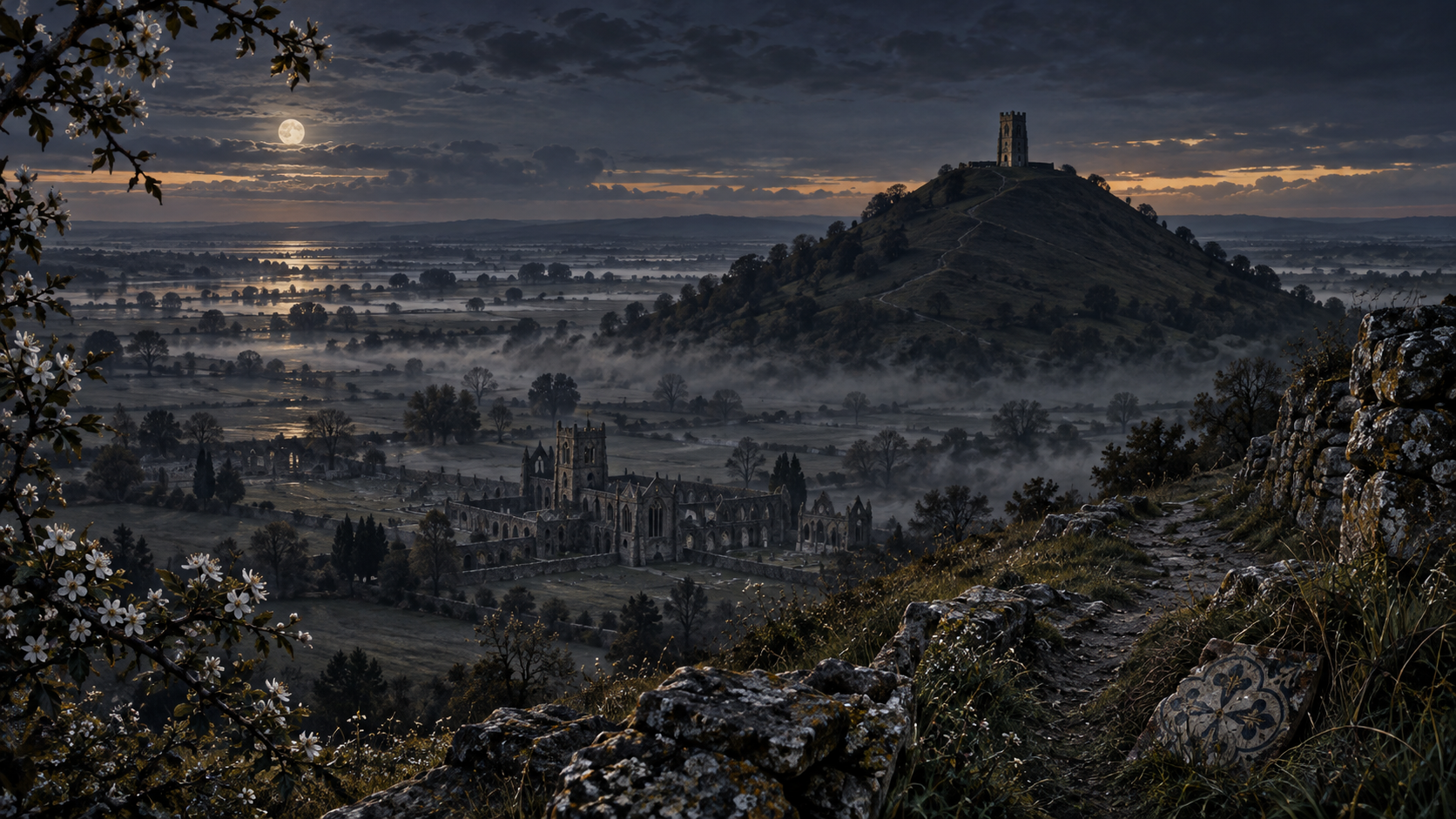
The real Glastonbury behind The King Beneath the Hill. No plot spoilers.
A tile carries Tamsin Hollis into Glastonbury in 1539. She restores ceramics for a living, so I went looking for the material history she might notice. It led me below the abbey floor and, unexpectedly, into the kitchen.
The abbey's last year
Glastonbury Abbey was a working religious house in 1539, not just the ruins we visit now. There had been a major fire in 1184 and centuries of rebuilding afterward. Its church, cloister, kitchens, gardens, and service buildings belonged to people who used them every day. The abbey's history and Historic England's record trace that long use.
In 1539, Henry VIII's government dissolved the monastery. Its last abbot, Richard Whiting, was executed on the Tor. Valuables were taken; the buildings were dismantled over time. Abbey stone went into the town and the causeway toward Wells. Historic England records where its stone went.
What the ground kept
Excavators found a layer of broken stone, glass, mortar, and other debris near the central buildings. In places it is more than a metre deep. It records dismantling on a scale the remaining walls cannot show us. Historic England describes the deposit.
Under the medieval abbey are older churches. Its first stone church, built around AD 700, had a floor made with reused Roman brick and tile. Excavations in the 1920s identified several Saxon phases beneath the later buildings. The abbey's archaeology page shows how much building and rebuilding took place on the same ground.
This was the detail I wanted for Tamsin: a tile already on its second life by the time someone laid it in a church floor. She would notice the material and the workmanship before she knew the whole story of the place.
The kitchen that stayed
The Abbot's Kitchen survived the dissolution, probably because it was still useful. It was built in the fourteenth century, square at the base and octagonal above, with four fireplaces. Conservation work has found signs of a gallery where a head cook could oversee the room. Glastonbury Abbey describes the kitchen, and Historic England records its survival.
It fed the abbot and his guests, not the monks. After the dissolution, people found other uses for it, and it kept its roof. That is the room I would take Tamsin to see.
Sources and further reading
Glastonbury Abbey — History; Glastonbury Abbey — The Saxon Churches; Glastonbury Abbey — The Abbey and Abbot's Kitchen; Historic England — Glastonbury Abbey scheduled monument.