
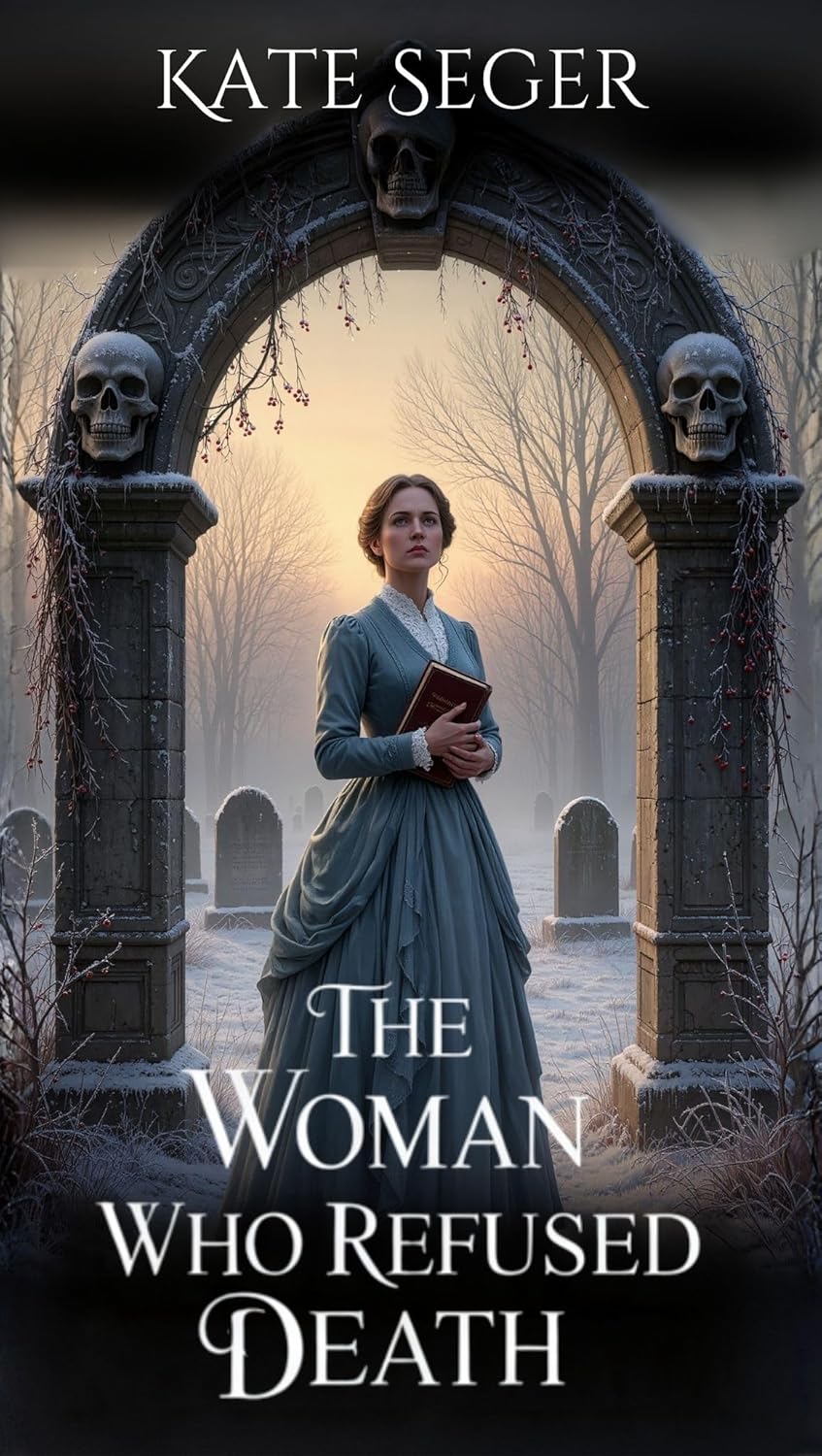
The Veilkeepers · Prequel
The Woman Who Refused Death
Dedication
For the women who learned holiness out of fear, who mistook survival for salvation, and still found the strength to speak.
Chapter One: The Strange Wife of Mill Brook
1902 — Mill Brook, Massachusetts
Mill Brook was the kind of town that pretended its shadows were normal, if it admitted they existed at all. A small, tight-stitched place between the river and a rise of pine-covered hills, where laundry snapped on lines and gossip traveled faster than horses ever had. In good years, the town smelled of lilacs and fresh-cut hay. In lean years, of coal smoke and damp wool.
Adelaide Hartford had lived here for five years, and Mill Brook still hadn't learned how to look at her without flinching.
She stepped out onto the front porch just after sunrise, shawl pulled around her shoulders, breath fogging faintly in the crisp air. Another cool morning. The kind that slipped under your collar and made you wish for an extra layer. The sky was pale, a faint wash of color behind the mill roofs.
She paused with one hand on the rail.
Across the lane, Mrs. Windsor hung out her wash, clothespins clamped between her teeth. At the sight of Adelaide, she stalled mid-motion. The bedsheet slumped over her arm. A moment too long passed before she forced her gaze away and fussed needlessly with the fabric.
Adelaide gave her a polite nod. Mrs. Windsor did not return it.
She never did.
Adelaide exhaled through her nose and tucked her chin deeper into her shawl. Everett said she shouldn't take the whispers personally—small towns like small explanations, he'd tell her—but it was hard not to miss how often people crossed the street to avoid her. How mothers pulled their children to the other side. How conversations thinned when she walked into a room.
Even the dog behind Mrs. Windsor's fence gave a low, uneasy sound.
Not this again, Adelaide thought. Not before breakfast.
She stepped off the porch, boots sinking slightly into the damp grass, and circled the house. She checked the windows one by one—first the latches, then each corner where she'd pinned small squares of scripture behind the frame. She pressed lightly on each paper. Still dry. Still secure.
She'd learned as a girl that sacred words could form a sort of boundary—less a wall than a curtain—enough to dissuade what she saw from coming close. They couldn't banish the dead, but they could make the world feel momentarily manageable. And some days, that illusion was all that kept her from unraveling.
Next she touched the sachet of dried lavender and rosemary tucked above the back-door lintel. A simple thing, meant for protection in old stories. She told herself it was nonsense.
But sometimes it steadied her hands.
That counted for something.
She paused, watching them—a habit, nothing more—just long enough to see the nearest one tremble.
A faint quiver.
Then—
—it chimed.
A single, bright note.
The sound slid through the air like a pin dropped into a well, falling farther than it should have. Adelaide went very still, the way a creature goes still when it realizes something else is listening.
The morning felt suddenly hollow around her, as though the world had stepped back to make room.
The bell never rang on its own. Not from wind. Not from birds. Only from touch—or from something trying to get her attention.
She took a step backward, her boots scraping against the grass. The temperature dropped so suddenly her next breath misted white. The bell swayed now, though nothing stirred it, and Adelaide could feel it… that unmistakable pressure of being watched. Being known. Being called.
This wasn't the faint brush of something passing by.
This was attention. Fixed. Intent. Patient.
Her name without being spoken.
Cold crawled up her wrists like fingers made of winter air.
“Please,” she whispered, barely a breath. “Not again. Not this morning.”
The bell stilled. The cold retreated by inches, as if whatever had been there was considering—weighing—deciding whether to insist.
Then, mercifully, it withdrew.
The morning warmth returned, but Adelaide's hands shook as she pressed them against her skirt.
Inside, Everett's voice drifted through the open kitchen door. Warm, sweet, familiar.
"Addie? You out there?"
She hurried inside and wiped her palms on her skirt before he turned around, willing her heartbeat to slow.
Everett Hartford was at the stove, sleeves rolled up, stirring a skillet of frying potatoes. His hair was mussed from running a hand through it too many times. He turned when he heard her step, and his face softened in that way it always did when she walked into a room, as though relief lived in him and surfaced only at her arrival.
"There you are," he said, brushing a loose strand from her cheek. "You alright?"
She nodded. Too quickly.
"Just checking the yard."
"You checked it last night."
"I know."
He studied her face for a moment, hazel eyes searching. Beneath his gentleness—just for a heartbeat—she saw a flicker of quiet exhaustion. The kind that came from loving someone he couldn't always protect.
"You're safe here, Addie," he said softly. "Truly."
Maybe he believed it. Maybe he needed to.
She wanted so badly to let the words settle inside her, warm and convincing. But her heart felt like something fluttering at the edge of escape, restless and unquiet.
"I know," she said. "I'm trying."
He pressed a brief, reverent kiss to her forehead. "Sit. Breakfast is almost ready. And remind me, I need to give you money for flour. Mrs. O’Sullivan's short on help today."
Adelaide moved toward the washbasin and picked up a dishcloth, willing her hands to steady.
After a moment, they did.
She checked the scripture behind the kitchen doorframe. Still straight. Still whole. Still here.
Later that morning, Adelaide walked the short path into town with her basket tucked close beneath her arm. The dirt road curved between peeling houses and tidy gardens, past the Carter farm with its slouching barn and the last uneven pumpkins softening in the cold. Mill Brook was waking slowly, sleepily. Men heading toward the mills or the rail depot outside town limits. Women tending wash or shooing chickens. Smoke rose from chimneys in thin gray ribbons.
Adelaide kept her steps quiet, her shoulders rounded. She tried to be small. Tried not to see how people shifted out of her path.
Children playing with marbles went silent as she approached. One boy grabbed his sister's hand and stepped back.
"Don't stare," the girl whispered, her eyes darting fearfully.
"I wasn't staring," he whispered back. "She's the witch." A beat. "Ma said so."
A small ache opened beneath her ribs.
She kept walking.
At the bakery, Katherine O'Sullivan greeted her with a brittle sort of politeness, the kind worn thin by too many recent condolences.
"Oh… Mrs. Hartford. Here for flour?"
Adelaide nodded. "Yes, please."
Katherine reached for the scoop. Her grip tightened around the handle, not shaking, but held too still, fearing what her own hands might reveal. The tin rasped softly as metal brushed metal, a small cloud of flour drifting across her apron. She swiped at it, missed most of it, then straightened the nearest stack of sacks, careful to avoid Adelaide’s eyes.
Grief rearranged people in small, telltale ways.
Thomas O'Sullivan had been gone two days. They'd found him in the lower pasture at dusk, his horse pacing uneasy circles. But Adelaide had seen him in a vision three days before, sudden and cold as a dropped stone. Thomas lying in the trampled grass, his body turned at an unnatural angle, one boot caught beneath him. His hat had rested a few feet away, as though it had tried to flee what he could not.
She'd tried to warn Katherine. Mind Thomas with the horses today. Please.
Katherine had looked at her then the way she looked at her now—startled, wary, as though Adelaide carried the echo of something she wasn't meant to know.
Katherine swallowed, her gaze drifting to the doorway, lingering there for a heartbeat. As if some stubborn, impossible part of her still expected Thomas to appear. Then she smoothed her apron, her palm pausing over the faint swell beneath it.
"He always said I wasn't to lift flour when I was expecting," she murmured, voice low and frayed. "But the ovens won't warm themselves, and… well. Little Tommy will need a roof come winter."
The name landed softly, a fragile tether in a room carved hollow.
She wrapped the flour in brown paper, then slid the parcel across the counter. Her fingers hesitated before she drew them back, as though the space between them held something neither wished to disturb.
"Have a good day, dear," she said, her eyes fixed on the counter instead of Adelaide.
"You as well," Adelaide whispered, though they both knew she would not.
Adelaide stepped into the cold air, relief loosening something inside her. The clouds had thickened; the light felt flatter now, the morning heavier.
She took the cemetery path home, not because she wanted to, but because the main road made her feel too exposed.
The hill was dotted with crooked stones, names and dates softened by time. She kept her gaze low, focusing on the path instead of the spaces between headstones where shadows sometimes held shapes they shouldn't.
It wasn't the place she feared. It was what lingered near places like this—curious, listening, hungry.
She almost made it past the oldest stone before she heard it.
Adelaide.
Her name. Soft as a breath. Cold as stone.
Her pulse stuttered, caught on something colder than the autumn air.
She stopped walking. Couldn't help it. Her boots seemed rooted to the path, her muscles locked tight with the animal certainty that something was wrong—that moving might draw its full attention.
“Deliver me from evil,” she whispered, clinging to the words the way a drowning woman clings to her last breath.
The temperature plummeted. The air itself changed, becoming heavy, pressing against her ears like she'd gone underwater. Sound warped and distorted: the distant mill wheel slowed to a funeral drum, birdsong stretched into something almost like screaming.
A breeze that wasn't breeze stirred the leaves at her feet in a perfect circle.
A shadow flickered behind a row of stones—too tall, moving wrong, at an angle that didn't match the sun.
Adelaide's skin prickled along her wrists and the nape of her neck. Every instinct screamed at her to run, but her grandmother's voice echoed in her memory: Never run from the dead. They love a chase.
And there—between two leaning markers—a figure stood.
Too tall. Too still. Not quite solid, more like smoke given the memory of shape.
But the worst part was its fixation. She could feel the weight of its gaze like hands pressing against her chest, her throat, her face. Studying her. Knowing her. Wanting something from her with a need that felt ancient and patient and absolutely inevitable.
Adelaide clutched the flour so tightly the paper crumpled in her grip.
She didn't look at the figure directly. Didn't turn her head. Didn't acknowledge it.
Don't see it. Don't name it. Don't invite it.
She took one step backward. Then another. Her legs felt like water, her bones like brittle ice, but she moved—slowly, carefully, never turning her back.
The figure didn't move, but she felt its attention intensify, pressing harder, a silent question: Will you acknowledge me? Will you help me?
"I can't," she breathed. "I'm sorry. I can't."
The air around the figure rippled with something that might have been rage or grief—she couldn't tell which. The cold deepened until her teeth chattered.
Then, with aching slowness, it began to reach toward her—
Adelaide broke and ran.
She ran down the cemetery path, her skirts tangling around her ankles, her breath coming in ragged gasps. Behind her, she could feel it watching—not following, but remembering her. Adding her name to whatever list the dead kept of those who could see them.
She didn't stop until her yard came into view. She stumbled through her gate and fell against the porch rail, chest heaving, cold sweat soaking through her dress.
With shaking hands, she checked the wards again—the bells by the kitchen window, the scripture behind the doorframe, the chalk sigil beneath the step.
All intact. All in place. All unchanged.
But her wrists still felt cold where invisible fingers had reached. The air still tasted of iron and turned earth. And when she closed her eyes, she could still see that figure standing between the graves, patient as stone, waiting for her to come back.
Because it knew what Adelaide was only beginning to understand: sooner or later, she always did.
⁂
Everett came home early that evening, cheeks pink from the wind, collar askew. He stepped in with a barely-contained excitement, something hidden behind his back.
"Addie," he said, almost breathless. "I've got news."
She straightened from where she'd been staring into the fire, trying to forget the cemetery. "What kind?"
“A promotion.” His grin widened. “Supervisor says I’ve been steady. Reliable. They’re giving me the evening freight runs at the depot. It means better pay, Addie. Enough to actually get ahead.”
Everett's joy was warm, bright, contagious. For a moment, she let herself be pulled into it, let herself believe that good things could still happen.
"That's wonderful," she whispered. "Truly."
"We're building a good life here, aren't we? Mill Brook is a blessing."
A blessing.
The word scraped raw against the memory of that figure reaching for her.
His smile faltered as he studied her face. "There was trouble at the mill today, though. Samuel Pritchard—do you know him? Works the looms near the back? He collapsed. Doctor says it's his heart. Days, maybe. A week at most."
Adelaide's pulse quickened.
Samuel Pritchard. A kind man. A good one. A man with a wife and three young children.
"That's terrible," she breathed.
"His wife asked for the priest, but Father McKenna's in Boston. She's desperate—wants someone to sit with him, pray over him. She doesn't want him to die alone." He hesitated. "I told her we'd pray for him at supper."
The thought hollowed something inside Adelaide, as though a door she’d tried to close had opened a fraction wider.
A man dying. No priest.
She thought of the boy she’d seen in the cellar of their old house, pale and pressed into the shadows as if something held him fast. And she thought of all the stories whispered in Mill Brook and every town before it—of mothers who wandered after death, of daughters who followed voices no one else could hear, of spirits that clung when death came wrong or too soon or without blessing.
Most were tales, she told herself.
But one or two… she’d seen enough to fear how close they came to truth.
Without a priest's words to guide him through, Samuel Pritchard's soul might cling to the living world. Might wander. Might find the one person in Mill Brook who could see him. Who could hear him calling in the dark.
"Everett," she began, voice shaking, "I… something happened today."
He sobered instantly, setting down whatever he'd been holding. "What is it, Addie?"
She opened her mouth—
She wanted to tell him. Wanted to spill everything: the bell that rang itself, the cold that shouldn't exist on a spring morning, the figure in the cemetery that had known her name and reached for her with hands made of need and grief.
Wanted to tell him that Samuel Pritchard's death would not be the end, that dying men sometimes saw beyond the veil, that their terror could tear them from their bodies too soon and leave them trapped, hungry, desperate, searching for anyone who might hear them.
He would listen—he always did—but he would hear her fear, not her truth.
He would think her fragile. Hysterical.
And if she told him the dead had spoken her name… that something impossibly tall had watched her in the graveyard… that she could feel death circling closer to their door like a wolf testing the wards—
He'd pray over her until dawn. He'd watch her carefully. Fearfully. He'd love her the way you love something broken that you're terrified of losing.
She couldn't do that to him. Couldn't let him see how thin the walls between worlds had become, how easily something might slip through if she wasn't vigilant.
"It's nothing," she said softly, the lie bitter on her tongue. "I'm just tired."
He hesitated—wanting to understand, unable to find a door into her fear. A shadow of sadness crossed his features, gone as soon as it appeared. He'd seen this before. The way she pulled back just when he reached for her. The secrets she kept even in her honesty.
He kissed her knuckles, holding her hands between his.
"You're all right," he whispered. "God watches us."
The lamp in the hall flickered. No draft touched it.
Outside, the brass bells at the kitchen window chimed once.
Adelaide closed her eyes against the sound.
The wards quivered. The shadows leaned in. And something ancient and inevitable moved closer to her—no longer asking, but expecting her to answer when it called again.
Somewhere in Mill Brook, Samuel Pritchard lay dying.
And Adelaide Hartford knew—with the cold certainty that lived in her bones—that when his soul finally tore free from his failing body, it would come looking for her.
The dead always did.
Chapter Two: The Sight
Night pressed close around the house, thick as fog on riverwater, quiet in a way that felt intentional. Adelaide lay beneath the quilt with her eyes open, watching the lamplight thread faint gold across the curtains. Everett slept beside her, his breathing steady in the untroubled rhythm of someone who belonged wholly to the living.
She turned toward him, catching the faint scent of woodsmoke and starch from the depot uniform he’d hung on the chair beside the bed. It should have calmed her. It usually did. But her heart beat in quick, desperate pulses, as though trying to outrun something she couldn’t name.
She could still hear the bell outside their window.
Just one chime.
Precise.
Intentional.
The memory of the cemetery clung to her like wet cloth: the voice curling her name through the air, the shape standing too still between the leaning stones.
Sometime later, Everett stirred.
“Addie…? You’re awake.”
“I couldn’t—” Her voice thinned. Everett didn’t press. He reached for her hand beneath the covers, his fingers warm around her cold ones.
“You’re trembling,” he murmured.
“Only a little.”
He brushed her hair back from her forehead. “Addie, love… the doctor said these spells come on when you’re tired. They’re echoes inside you, that’s all.”
“They feel close,” she whispered.
A shadow crossed his face. Sorrow, not fear.
“I know they do,” he said. “But they aren’t real. You’re here with me. Nothing can hurt you.”
She wanted so badly to believe him. But she’d grown up knowing the dead were not aimless—they lingered with purpose.
They reached for people who could see them.
Sometimes they reached because they needed to be led.
Sometimes because they wanted company in their grief.
And sometimes… because they mistook her for something she wasn’t.
⁂
When Everett rose for work at dawn, she watched him move through the kitchen, humming a hymn as he packed his lunch. He buttoned his coat, brushed her cheek with his fingers, and kissed her temple.
“Home before dark,” he promised. “Depot only needs me half a shift today.”
She nodded, holding onto the words until he vanished down the lane.
But warmth didn’t linger long in the Hartford house.
The bells at the window trembled faintly. Adelaide’s breath caught. She wrapped her shawl around her shoulders and stepped outside, boots whispering over frost-laced grass, her senses stretched thin.
She didn’t plan to go to the chapel—yet her feet led her there anyway.
The church was empty at this hour. The soft scent of candle wax hung in air painted in muted colors by stained glass. Adelaide slipped into a back pew, letting her hands settle in her lap. She bowed her head, but prayer rose slowly in her chest, snagging on memory.
She was eight again, standing barefoot beside her mother’s deathbed. The sheet drawn up to her mother’s shoulders. The room too silent. Too still. Her mother’s shape—translucent, sorrowing—stood at the foot of the bed, watching her own waning body.
“Mama?” little Adelaide had whispered.
The figure turned.
Smiled.
A familiar face made strange.
She’d screamed until her father seized her by the arms, his own face gone white with terror as he begged her to stop. But he never spoke of it afterward. Not the scream, not the vision, not the way she trembled for days. He simply told her it had been a dream and drank himself deeper into silence.
It didn’t stop there.
When Adelaide was nine, at her cousin’s funeral, she’d seen the girl’s ghost drift between the mourners—gray around the edges, reaching for her little brother. Adelaide had whispered a warning without meaning to. Half the church heard. People remembered.
Three years later, she’d been fetching nails from the farrier’s barn when she heard a voice whispering behind the stalls. Soft. Urgent. No one else reacted. Adelaide answered—just a few words, barely breath—and the farrier’s wife made the sign of the cross. The farrier grabbed her by the shoulders and threw her out onto the road.
By then her father had faded almost completely, lost in a grief so vast it blinded him to everything else. Even to her. He never saw how the neighbors watched her. He never heard the rumors that she was possessed, or the way people said a child who talked to empty corners had let the devil step through.
And when he finally followed her mother into the ground, no household in Springfield wanted a girl who saw what should remain hidden. Adelaide grew up in borrowed corners of relatives, whispered about, avoided, carrying a reputation she never asked for, shaped by things she could not unsee.
Until Everett.
Everett, who’d arrived on her aunt’s stoop with his cap in hand, asking if they needed anything done around the house. Asking nothing in return. He came back the next day, and the next, fixing a hinge here, carrying firewood there, speaking gently to a girl the town had already named unnatural.
He stayed kind, even when she flinched at shadows he couldn’t see. And in time, kindness was something she didn’t know how to refuse.
Adelaide opened her eyes. The chapel felt too quiet. She rose slowly, a tightness coiling in her stomach. When she stepped outside, the morning light felt thinner, as though something were filtering it before it reached her.
She hurried her pace, but unease clung to her like a second skin.
Her wrists tingled.
Her breath shortened.
A pressure gathered behind her eyes—the unmistakable sensation that the veil was thinning.
Two streets from home, she stopped abruptly.
Samuel Pritchard stood at the corner near the tailor’s shop, leaning against a lamppost as though bracing himself against a heavy wind. His face had lost its color. His eyes drifted, unfocused. His breath—if it was breath at all—moved shallowly.
He hadn’t died yet. She sensed that.
But he was slipping.
Half-here, half elsewhere, caught in a current pulling him toward the other side.
“Samuel?” she breathed.
His head turned.
His gaze sharpened as it found her, recognition flaring through the haze, terrible and pleading.
He raised one shaking hand toward her.
“Help me,” he mouthed.
Not confused.
Not aimless.
He was reaching for her specifically.
Adelaide staggered back.
“Don’t—Samuel, please—”
One unsteady step.
And then he vanished.
Gone, as if pulled through a slit in the air.
The scream clawed at her throat. She turned and ran, barreling home with her pulse thundering in her ears.
The door rattled when she slammed it. The bells above the window clattered in a sharp metallic shiver. She pressed her back to the wood, panting.
When she forced herself to check the wards, her stomach dropped.
The lavender sachet’s string hung by a single thread.
The scripture behind the frame curled at the corners.
The chalk sigil beneath the step bore a smeared streak. More than a mark. A deep indentation dragged through the center, as though something had pressed down hard… and left cold residue where a finger had been.
She felt it still. A faint chill brushing her ankle.
Something had pushed through.
Not to enter—but to test her.
The air tasted of iron.
Of earth just turned.
Of something moving through the house, confident she could not stop it.
“I didn’t ask for this,” she whispered. “I didn’t ask to see.”
Only the silence answered.
She gathered chalk, fresh lavender, new strips of scripture. Her hands shook as she redrew the sigils, restrung the bells. But even as she worked, she knew: wards only held back what was willing to be held back.
Whatever was coming no longer cared about her defenses.
She lit every lamp she owned, even as daylight clung stubbornly to the windows. The light felt thin, as though it passed through a layer of frost before reaching her hands.
A knock jolted her so hard she dropped the match tin.
A woman stood on the porch with a basket of apples, shifting her weight as though debating whether to knock a second time.
"Good afternoon," she said when Adelaide opened the door. "Eliza Finch. My husband and I just moved in down the lane. We've more apples than we can store, so I thought I'd bring a few by."
Adelaide managed a nod. "That's... very kind of you."
Eliza's gaze drifted to the chalk mark beneath the lintel. Adelaide's breath caught, shoulders tensing, bracing for the familiar pattern. The sharp intake of breath. The step backward. The sudden remembering of somewhere else to be.
Instead, Eliza paused there for just a heartbeat, her expression shifting. When she looked up again, there was understanding in her eyes, but nothing like fear.
"Good placement," she said quietly, then offered an easy smile. "We're new to Mill Brook. Seemed right to introduce myself properly."
Adelaide blinked, uncertain. Most people pretended not to see her wards. Some pretended not to see her at all. But Eliza stood there as though the chalk marks were simply part of a doorframe, as unremarkable as hinges.
"If you need anything," Eliza added, offering the basket with both hands, "I'm just down on Maple Street. Third house past the oak."
"Thank you," Adelaide whispered, taking the basket. The apples were solid and warm in her hands. Real. Normal. Safe.
Eliza nodded once, then stepped back from the porch and moved down the lane. Not rushing. Not casting a backward glance. As though nothing about Adelaide Hartford was strange at all.
Adelaide stood in the doorway long after Eliza disappeared, the basket heavy against her hip and something fragile stirring in her chest.
Maybe Mill Brook had room for one person who didn't flinch at shadows.
Or maybe—and this felt even more dangerous to hope—maybe Adelaide had finally found someone who understood why the shadows needed watching in the first place.
⁂
The house dimmed as the sun sank and her mood went with it. She lit fresh lamps. Their glow did little to warm her.
For a moment—just as she turned from the last lamp—a shape flickered in the corner of her vision. A man’s outline. Stooped. Breathless. Reaching.
She spun.
Nothing there.
But the cold clung to her wrists, the same cold she’d felt in the cemetery.
Samuel Pritchard.
Or what remained of him.
By the time Everett stepped through the door, Adelaide sat rigid in her chair, shawl drawn tight. He took one look at her and knelt beside her, his thumb brushing her chilled hand.
“What’s wrong?” he murmured.
She opened her mouth. Nothing came.
“Addie.” His voice softened. “Please. Tell me.”
She looked at him—the man who saved her, who believed fear shrank under prayer, who thought the world was kinder than it was.
“I think Samuel Pritchard is already gone.”
Everett blinked, confusion lining his brow.
“Addie… he’s ill. The doctor said—”
“I saw him yesterday,” she whispered. “On the street. And he saw me. He asked me to help.”
Everett hesitated, worry shading his features.
“Maybe it was someone who—”
“He vanished, Everett.”
Everett swallowed.
He didn’t argue.
Didn’t question her.
He simply gathered her hands in his, warm palms enveloping her cold ones.
“You’re frightened,” he murmured. “Let me sit with you awhile.”
She nodded, and he pulled a chair close, settling beside her.
After a moment, he began telling her about his day. Small, ordinary things. The supervisor’s new roster. The updated hours. Miller’s baby. A joke the depot men passed around.
“They’ve got me on steadier shifts now,” he said, voice warm with relief. “Just like I told you. No more last-minute calls. After tomorrow, things should settle.”
A pause.
Softer:
“Tomorrow’ll be calm, Addie. I promise.”
The words chilled her more than the cold air ever had. Something about the promise…
She almost reached for his hand. Almost asked him not to go to work tomorrow.
But what would she say? I have a feeling?
He’d tell her she was tired. Tell her she needed to rest more and stop fretting.
So instead, she forced a smile.
“That’s wonderful,” she whispered.
But dread thickened in her stomach, curdling.
He stayed beside her until her trembling eased, then eventually, he rose and kissed her forehead.
“Come to bed when you’re ready,” he murmured. “I’ll keep the lamp burning.”
She nodded but didn’t move.
After he climbed the stairs, she sat alone in the dim parlor, listening to the house settle around her.
The bells on the window trembled once.
Twice.
Three times. Urgent, warning.
Then fell silent.
Adelaide closed her eyes and wrapped her shawl tighter.
Samuel Pritchard was dying—or dead.
The veil was thinning.
And something had taken notice of her.
Something patient.
Something powerful.
Something drawing near.
And Everett expected her to act like everything was just fine.
Chapter Three
Morning didn’t so much arrive as hover, gray and hesitant, like something unsure whether it should enter the house at all.
Adelaide woke before Everett. She lay beneath the quilt, listening to the hush of the house. No birdsong. No wind brushing the eaves.
Everett stirred beside her and smiled sleepily, unaware of the dread carving a hole in her gut.
“Mornin’, Addie.” He brushed his nose against her temple. “You get any rest?”
She nodded, though her eyes burned. “Some.”
He rose, humming as he dressed. There was a lightness to Everett that she wished she could share, joy tucked into every movement. He had steadier hours now, a promotion, a future he believed he could hold. He didn’t see the fear that shadowed the corners of the room.
She watched him pull on his coat, smoothing the collar as he always did. He noticed her gaze and stepped close, kissing her cheek.
“Tell you what,” he murmured, brushing her hair back. “On my way home, I’ll stop by O’Sullivan’s bakery and bring you those ginger biscuits you like. Seems fitting, now that things are looking up.”
The words rang hollow inside her chest.
When he stepped onto the porch, the bells by the window chimed.
Everett laughed lightly. “Wind must’ve caught ’em.”
But Adelaide felt no wind.
She tightened her grip on his sleeve. “Everett… just—be careful today. Please.”
He covered her hand with his own. “Always am.”
She almost told him everything. Almost begged him to stay home.
But fear held her tongue.
He kissed her knuckles.
“I’ll be home before you know it.”
Then he stepped into the lane, and the house felt colder for it.
⁂
The daylight had an odd quality—flat, muted, as if passing through smoke. Adelaide moved through the rooms, trying to pretend nothing was amiss, but the world refused to play along.
Adelaide reached for the kitchen doorframe, fingers seeking the familiar slip of scripture tucked behind it—
—and froze.
The paper was damp.
Soft.
Sinking in on itself.
Words that had held for years blurred as if drowned, the ink feathering outward in black veins that crawled across the page like something alive.
A sour, earthy smell rose off it.
Grave-cold.
Rot.
She jerked her hand back.
“Mother of God…” she breathed.
Not a prayer.
A realization.
Something had touched her strongest ward.
And it had ruined it from the inside out.
Adelaide steadied herself with a breath and turned toward the window.
The pines stood unnaturally still—stiff as carved posts—while the river beyond them rippled as if something had disturbed it.
Wind on the water.
But not on the trees.
Her skin prickled.
Something was wrong.
Deeply wrong.
She backed away from the window, arms wrapped tight around herself.
The sound came minutes later.
A distant metallic scream. A tearing, rending cry that cleaved through the quiet. Birds erupted from the trees in frantic clusters. The lamps rattled in their hooks. The earth itself quivered beneath her feet.
Adelaide whispered, “Everett.”
A muffled boom followed.
Then shouts.
Dozens of voices.
A rising, terrible wail.
She didn’t remember unlatching the door. Or stepping onto the path.
She only ran.
Branches clawed at her skirts. Smoke thickened the air. Her lungs burned. Something—some unseen force—pulled her forward by the bones.
Around a bend.
Down the slope.
Toward the rail line just beyond the trees, where the freight passed every morning.
Where Everett had promised to be.
Smoke billowed between the trees, black and dense.
The tang of hot metal choked her.
When she reached the clearing, her breath shattered.
The freight train lay twisted on its side, cars splintered, wheels torn loose, iron screaming as it cooled. One axle lay half-buried in the dirt like a snapped limb. The ground was ripped open in deep, violent gouges. Men ran, calling out names. Mothers clutched children. Someone sobbed uncontrollably.
Her sight flared, white-hot.
Ghosts—fresh, trembling silhouettes—hovered near the wreckage. Some drifted in shock. Others knelt beside bodies, whispering silent pleas. Still others reached for the living, fingers passing through flesh like smoke through glass.
Death had come here.
Death was here still.
She staggered forward.
A tug pulled at her chest, gentle but insistent. Not a voice—an instinct. A knowledge.This way.
She followed it around a shattered railcar, over bent track, past sparking wire.
Then she saw him.
Everett lay pinned beneath a twisted wheel housing, crushed at the legs. Blood darkened his shirt, seeping into the dirt. His breaths came shallow, fluttering like torn leaves.
But when he saw her, his eyes opened fully. Softened with recognition. With love.
“Addie…” he breathed.
A sob tore from her.
She dropped to her knees and grasped his hand. It was still warm—life warm—and the familiarity of it nearly broke her. She remembered absently, absurdly, the way that same hand had brushed flour from her cheek in their first kitchen together, laughing softly as though he couldn’t believe she’d chosen him.
“I’m here,” she whispered. “I’m right here.”
He tried to smile, but it faltered beneath pain.
“Don’t cry,” he murmured, thumb brushing weakly against her fingers, the way he always did when trying to soothe her.
She clutched his hand tighter. “Help is coming. They’ll get you free, Everett. Just hang on. Please, hang on.”
His breathing hitched. “Addie…” He swallowed, voice paper-thin. “I’m not afraid if you’re with me.”
“No—no, Everett, you’re not—” Her voice cracked. “Not like this. Not you.”
He winced, a tremor running through him.
“Sweetheart,” he whispered, “I love you. You know that, don’t you?”
Her heart split.
He exhaled a threadbare breath.
And then she felt it.
His hand—still in hers—grew lighter.
His pulse turned wistful, faint as the brush of moth wings.
His form blurred at the edges.
“No,” she pleaded. “Everett, stay. Stay with me. Please—”
But something shifted.
The veil opened.
Smoke stilled.
Voices dulled.
The world dimmed, as though dipped beneath water.
A presence formed behind her, neither shadow nor light, but something between.
The air snapped.
A thin crack of ozone bit the back of her throat, and the smoke around her trembled—lit from within by a brief, silent flash of blue-white.
Then a figure stepped through the haze.
Tall.
Composed.
His coat stirred though no wind touched it, the faint scent of lightning drifting in his wake. His eyes—pale, ancient—settled on Everett first.
Then on her.
“You see me,” he said, voice low and reverent.
Adelaide’s breath hitched. “Who…who are you?”
“I am Andromalius,” he said simply. “Keeper of the threshold. Guide of the departed.”
She stared at him, at the inhuman stillness in his posture, the subtle dissonance that made the hairs on the back of her neck stand on end.
“What do you want?”
“I am here for him.” He knelt beside Everett with a fluid grace that defied human movement.
Everett’s eyes flickered, focusing past her onto the stranger. Not with fear. With wonder. As though recognizing something intrinsic to the world.
Adelaide’s panic surged. “Don’t touch him! Don’t take him from me!”
Andromalius looked at her—calm, curious. “I do not take,” he murmured. “I guide.”
“You can’t,” she whispered. “He’s still breathing. He’s still here—”
“His tether thins.”
He lifted a hand over Everett’s chest.
The air hummed.
“He held on longer than most. For you.”
Something inside her went still, as if her own heart had missed the step his could not.
Everett blinked up at her, not in pain now, but in peace.
“Addie…” His voice trembled with fading life. “Thank you. For every day.”
“No,” she sobbed. “Everett, please—please—”
His fingers slipped from hers.
His chest stilled.
For a heartbeat, she saw him twice: the broken body beneath the wheel… and the faint, shimmering outline rising gently from it.
His spirit turned toward her, light flickering softly.
“Don’t be afraid,” he whispered.
Then he reached—
hesitated—
as though wanting one last touch—
before Andromalius placed a hand beneath him and lifted.
Everett’s spirit wavered, looking back at her with love so pure her knees nearly gave out.
And then he crossed the threshold.
Silence fell.
Andromalius rose, studying her with quiet intensity.
“It is uncommon,” he said softly, “for a mortal to witness a crossing with such clarity. Rarer still to be seen in return.” A slight tilt of his head. “He waited for you.”
Her sobs broke anew.
“You possess the sight,” he continued. “One foot in life, one in death. A gift your kind seldom inherits.”
Adelaide shook her head, trembling violently. “No. It’s a curse. It always has been.”
“A curse?” he echoed. “To know what others fear? To see truth where others see only shadow? That is no burden, Adelaide Hartford.”
He extended a hand.
A pale, glowing stone appeared in his palm—silver glass, luminous and cold, pulsing like a distant star. It tugged at something deep within her, something she’d spent her life trying to bury.
“A calling,” Andromalius said. “This stone would make you more than a witness. It would give shape to your sight. Let you guide the lost across. Walk with me, and your fear will cease to be fear.”
His voice softened.
“You already see the wandering dead. Samuel Pritchard. The others who whisper to you. You could ease their pain. Give purpose to your gift.”
She stared at the silver glass, felt its pull like gravity.
But all she could see was Everett’s body beneath the wheel.
All she could feel was grief.
“Walk with me,” Andromalius said. “Become what you were born to be.”
She recoiled.
“You want me to serve Death? To become like you?” Her voice broke. “You just took my husband. You think I would join you?”
“I did not take him,” Andromalius said. “The accident took him. I merely—”
“No.” Adelaide’s grief hardened into something sharp. “My sight is a cross, not a vocation. I won’t use it. I won’t become… this.”
She gestured at his stillness, his gaze, his impossible presence.
“I choose life,” she whispered. “I choose to stay among the living.”
The stone dimmed.
Vanished.
Andromalius regarded her for a long, motionless moment, not angry, but cold with the kind of disappointment reserved for creatures far older than the world.
“You refuse,” he said softly.
Tears streaked her face. “Yes.”
“Then remember this.” His voice grew quieter, more terrible. “The dead will not cease calling simply because you denied me. And without the stone, you will have no power to answer… or to silence them.”
He looked once more at Everett’s body, then back at her, studying her as if committing her to memory.
“I do not forget those who turn from the threshold.”
The air rippled around him.
He dissolved into the smoke.
The world crashed back in a burst of sound—screams, metal groaning, men shouting—but it all sounded far away.
Adelaide knelt beside Everett’s still body, her fingers hovering where his spirit had been. Her palms were scraped raw. Her dress torn. Her lungs burned.
But she felt none of it.
Only the hollow space in her heart where Everett had been.
Someone touched her shoulder—a rescue worker, face streaked with soot. “Ma’am, we need to move him. There are others—”
She didn’t respond.
Couldn’t.
“Was he yours?” he asked softly.
She nodded, mute.
“I’m sorry,” he whispered. “Come away now. Let us do our work.”
But Adelaide stayed kneeling, unable to leave the place where Everett had crossed, where the veil had opened and shown her a fate she had refused.
From the distant chapel tower, the bells rang once.
Then again.
And again.
Nine times—the death knell.
And somewhere beyond the ruin, the veil shivered.
As if something vast had taken note of her decision.
Something that would not forget.
Chapter Four: The Cost
Three days had passed since the wreck. Three days of neighbors bringing food she couldn’t eat, of sleep that wouldn’t come, of waiting for a funeral that felt both too soon and unbearably delayed.
The day of the funeral dawned gray, a low ceiling of cloud pressing over Mill Brook as if the sky itself had stooped in mourning.
Adelaide woke to the quiet creak of the house shifting around her, the empty space beside her in the bed a hollow that no amount of blankets could warm. For a moment, still caught between sleep and waking, she reached for Everett’s shoulder, fingers closing on nothing but worn linen and cold air.
Memory returned like a blow.
The wreck.
The twisted metal.
The way his hand had slipped from hers.
She lay there a long time, listening to the stillness, until the church bell rang in the distance, one slow, solemn toll after another, calling her to the chapel on the hill.
She dressed in black with hands that did not seem to belong to her, fastening buttons without feeling the fabric. Everett’s spare coat still hung on its peg by the door. She paused, fingers brushing the worn wool, breathing in the faint scent of him that lingered.
“I don’t know how to do this without you,” she whispered into the empty room.
The coat did not answer. The house did not soften.
She stepped outside.
The walk to the chapel passed in a muted blur. People watched her from doorways and windows, from porches where laundry had been left half-hung. Hats tipped. Heads bowed. Conversations fell away to murmurs as she passed.
She did not look up to see who stared. She kept her eyes on the road, on the muddied snow at its edges, on the way her boots left small, dark crescents in the damp earth.
At the chapel, Everett lay in a simple pine coffin at the front of the nave, a spray of winter flowers resting where his hands were folded. He looked almost alive—Frederick Harrow had tended him with such care that, for a moment, she expected his chest to lift with breath. The stillness was the only betrayal.
Father McKenna spoke of heaven and mercy, of rest and reward. The words floated over her like smoke. She heard them and did not hear them.
She sat in the front pew, hands twisted together in her lap until the joints ached. The candles threw soft light over the coffin, over the priest, over the faces turned toward her with a mixture of pity and curiosity.
Everett should have been sitting beside her, whispering observations about who had managed to stay awake through the sermon, slipping his hand into hers when no one was looking.
Instead, he lay quiet and far away, and the space at her side stayed empty.
When the service ended, people approached in a slow, uneven line.
“Anything you need, dear.”
“We’re all so sorry.”
“Such a good man. Such a shame.”
Their words blurred together. She nodded when she was supposed to. Murmured thanks when her lips remembered how.
Several did not come near her at all.
Mrs. Finch did.
She stepped forward without hesitation and took Adelaide’s hand in both of hers—warm, steady, unafraid.
“You’re not alone,” she said softly. “Not while I’m near.”
She gave a small, grounding squeeze before stepping aside. No speeches. No fear. Just kindness.
Conductor Miller came last, hat twisting in his fingers. He looked younger without his cap, nakedly uncertain.
“Mrs. Hartford,” he said, voice scraped raw. “If I’d known… if I’d thought there was even a chance that—”
She cut him off with a small shake of her head. “It wasn’t your fault.”
His throat worked. “If he hadn’t taken my shift—”
“It wasn’t your fault,” she repeated, more firmly. “You have a family. Everett would have wanted you home with them.”
He flinched at the word family, then nodded, tears swimming unshed in his eyes.
“He spoke well of you,” he managed. “Said you made even a poor man feel like he’d come into riches.”
Something splintered in her chest at that, but she held herself still.
“Thank you,” she whispered.
He turned away quickly, shoulders hunched, guilt clinging to him like smoke.
Adelaide watched him go, and for the first time a cold thought slipped through her grief: How long before guilt turned to suspicion? How long before the town began asking: Why was she there so quickly? How did she find him in all that chaos?
She pushed the thought away, but it lingered at the edges of her mind like the smell of smoke after a fire.
When everyone had gone, when the last murmur faded, Adelaide rose on stiff legs and stepped up to the coffin. She laid a gloved hand on the smooth wood.
“Forgive me,” she whispered. “I knew. I should have warned you. I just didn’t think…” She couldn’t finish.
The candles guttered in a small draft; their flames bent, then steadied.
It felt like no answer at all.
She followed Everett to the graveyard and watched as the coffin was lowered.
The thud of dirt on wood echoed louder in her ears than any sermon.
When it was done, and the others drifted away in their clusters of black and gray, she stayed a little longer, listening to the winter wind move through the bare branches.
The dead were close here.
She felt them pressing at the edges of her senses—soft shapes, faint impressions, the way low tide reveals all the things that hide beneath water.
Not Everett.
Never Everett again.
He was gone—cleanly taken, carried past her reach. Somehow she intrinsically knew that.
But something else lingered.
Her breath caught.
Far across the cemetery, half-obscured by a leaning row of stones, a tall, motionless figure stood.
Too far to see clearly.
Too still to be living.
Watching.
The wind shifted.
Branches creaked.
When she blinked, the figure was gone.
But the cold it left behind curled around her spine like a hand.
Only when the cold had seeped deep into her bones did she turn toward home.
⁂
The town felt changed in some small, indefinable way. People nodded, offered condolences, but their eyes slid away too quickly now. Conversations did not fall silent out of politeness but out of something colder. Unease. Wariness.
She felt it like a draft across the back of her neck.
The thought slid in then, cold as January water: How long before guilt soured into suspicion? How long before someone asked why she was there so quickly? How she found Everett in all that chaos?
At the corner by the tailor’s shop, Adelaide paused.
Just beyond the edge of her vision, Samuel Pritchard stood in the alley’s mouth—thin, pale, blurred at the edges.
When she turned fully, he was gone.
But she knew.
The doctor had confirmed his death yesterday.
And yet here he lingered, waiting for an answer she could not give.
“You’re tired,” she told herself aloud. “That’s all.”
The lie tasted thin.
By the time she reached the house, the sky had sagged lower, heavy with unfallen snow.
She stepped inside and shut the door softly behind her.
The quiet met her like a solid thing.
No humming from the kitchen.
No scuff of boots being shed by the threshold.
No clink of Everett setting the kettle to boil.
She slipped off her gloves and coat, hanging them beside his. The sight of his jacket, the way it sagged without him, made her look away.
She lit the lamps one by one as the light failed outside. The flame took on the first strike, then the second, then the third, catching easily. The small circle of brightness in each room made the house feel narrower, not safer, as though the darkness were waiting just beyond reach.
Adelaide moved through the rooms on restless feet, straightening things that did not need straightening, wiping clean surfaces that were already clean. Her fingertips brushed doorframes where scripture tucked behind the wood had grown soft at the edges. She pressed each scrap more firmly into place.
At the back door, the lavender sachet she’d placed weeks ago sagged, the twine beginning to fray. She touched it lightly. The buds inside had lost most of their scent.
She took it down and replaced it with a fresh one from the small bundle on the shelf. One more small defense against a world that felt increasingly indefensible.
As she tied the new sachet, the bells at the kitchen window chimed again. A bright little sound in the quiet.
She went still.
The air around her cooled, brushing the hairs along her arms.
“Everett?” she whispered, hating the impossible hope that slipped into the word.
Silence met her.
Then, soft as a sigh slipping under a door:
Adelaide…
Her heart lurched.
She turned her head slowly, listening. The voice did not come from the window or the door or any corner of the room. It seemed to curl from everywhere at once—the walls, the floorboards, the hollow space under her ribs.
Another voice joined it—thin, younger:
Cold. So cold.
And then a third, lost and trembling:
Where is the door?
Finally, Samuel’s voice, thin with desperation:
Adelaide. Help me.
Her skin prickled along her wrists.
“You have no right to be here,” she said more sharply than she meant to. “Go to your rest. Leave me alone.”
The lamps flickered. One flame shrank to a trembling point, then flared again.
The bells chimed a third time.
Adelaide pressed the heels of her hands against her eyes until stars swam there.
“This is grief,” she told herself. “Nothing more. Grief and nerves and lack of sleep.”
Andromalius’s voice rose unbidden in her mind:
The dead will not forget you simply because you denied me.
She shook her head hard, as though she could empty his words out.
She made herself eat a few bites of the soup Mrs. Finch had left on the porch, a small note tucked beneath the bowl: For supper. No need to return the jar.
It had gone tepid by the time she brought it inside, but she appreciated the sentiment.
At some point the clock struck the hour. She did not register which one.
When the lamps burned low, she refilled them with careful hands. The house seemed to lean in around her, listening. Every creak of the rafters sounded like a footstep. Every sigh of the shifting stones beneath the foundation like a breath.
She tried to pray.
The words snagged in her throat.
“Lord,” she whispered finally, palms pressed together so tightly her fingers throbbed. “If this is a test, I have nothing left to prove. If this is punishment—” Her voice broke. “I don’t know what I’m supposed to learn.”
The only answer was the faint tick of the clock.
She climbed the stairs to the bedroom she had shared with Everett and stopped in the doorway. The bed waited, sheets cool and undisturbed. His pillow still bore the faint hollow of his head.
She couldn’t cross the threshold.
Instead, she turned and went back down, wrapping herself tighter in her shawl. She lay on the parlor settee with the candles burning low around her, too tired to keep her eyes open, too afraid to let them close.
At some point the exhaustion won.
She dreamt of the wreck and the river at once—of twisted rails and drifting ice, of Everett standing on the other side of a churning current, reaching for her with hands made of light. Behind him stood Andromalius, patient and still, holding the silver glass. It pulsed in rhythm with her heartbeat.
“Choose,” a voice whispered. “Cross or stay.”
“I can’t,” she said. Everett’s face began to fade, replaced by dozens of others—Samuel, the dead from the wreck, faces she didn’t know. “I can’t come to you, and I won’t go with him.”
Andromalius’s voice folded into the rushing water:
“Then you will belong to neither.”
The current rose, swallowing the sound of her reply.
She woke with a sharp gasp, heart pounding.
The candles had burned down to stubs, wax pooled and hardened on the saucers. Shadows gathered thick in the corners, pressed close around the ceiling. The lamps had gone out entirely.
She sat up slowly and rose from the bed.
The room was very cold.
Her breath smoked before her in a faint plume.
She fumbled for the matchbox on the table, fingers numb. The first match snapped in her hand. The second caught and flared—then, just as she reached it toward the nearest lamp, the flame died, snuffed by no breath she could feel.
Adelaide stared at the thin coil of smoke rising from the blackened tip.
A chill slid along her spine.
She struck one last match. This one lasted a heartbeat longer, bright enough to throw her own frightened face into brief relief in the nearby window, then winked out as though pinched between invisible fingers.
“Stop,” she whispered.
The room did not oblige.
A draft she could not place tugged at the edge of her nightdress, lifting it.
She stood there, clutching the matchbox, listening to the thick hush. Every part of her wanted to flee, to run into the night, to pound upon a neighbor’s door, to throw herself at Father McKenna’s feet and beg him to chase the shadows away.
Instead, she whispered, “No.”
Her voice trembled, but held.
“I said no. I meant it.”
The shadows seemed to pulse around her, not retreating, not advancing. Waiting.
“Whatever you are,” she said, barely more than breath, “you’ll get nothing more from me. I won’t cross your threshold. I won’t be your… your bridge.”
Her fingers dug into the wood of the matchbox.
“I don’t belong to you.”
Somewhere in the house, a board creaked. A soft knocking came from the far end of the hall—three slow, measured taps, like knuckles rapping from the inside of a wall.
Adelaide…
Her name slid through the air like a thread of cold water.
She squeezed her eyes shut. “Go away.”
Silence followed. Not relief. A pause.
When she opened her eyes, the room was the same. The dark was the same. The cold was the same.
Her hands were shaking too badly to risk another match.
She sank back onto the settee, drew her feet up beneath her, and sat there in the dim, listening to the rafters shift and the walls creak softly around her until the gray of morning began to seep in around the edges of the curtains.
By daylight, everything looked smaller.
The house felt wrong without him.
She moved through the rooms in a daze, scraping wax from a dish, trimming wicks that were already trimmed. The quiet pressed against her whole body. Even the clock on the mantel seemed to hesitate between ticks.
She passed the table and stopped.
Everett’s Bible lay where he’d left it that morning, a ribbon marking the passage he hadn’t finished.
Her fingers hovered above it, trembling but never touching.
He would never finish that passage now.
A hollow opened beneath her breastbone.
Before she could talk herself out of it, she wrapped her shawl tight around her shoulders and stepped back into the cold, starting up the hill toward the chapel once more.
⁂
Father Mckenna found her already kneeling when he emerged from the vestry, hands clasped so tightly the skin over her knuckles shone.
“Mrs. Hartford,” he said gently, taking a place on the pew beside her. “You should be resting.”
“When I rest,” she murmured, eyes fixed on the crucifix above the altar, “I see him.”
“Everett?”
“Him, and…” Her throat tightened. She swallowed against it. “Other things.”
Father Mckenna waited, his silence an invitation.
“I hear them,” she said finally. “In the house. Whispering. Calling my name.” Her voice dropped to almost nothing. “I feel them in the walls.”
His brows knit in concern. “Grief can be… unkind, Adelaide. It can make the mind see what the heart fears. There is no shame in that.”
“It isn’t grief.” She shook her head, fingers digging into her skirt. “I know grief. I’ve lived with it for years. This is different. This is…” She groped for a word and found only the memory of pale eyes in the smoke. “This is him keeping his promise.”
“Who?” Father Mckenna asked softly.
The name burned in her mouth.
“Andromalius,” she whispered. “He came for Everett. Offered me something. I said no. He said the dead would not leave me. And now they don’t.”
Father McKenna’s expression tightened. Quick, stark discomfort, as though something in her presence scraped against his sense of the sacred. His hand twitched toward the crucifix at his throat before he forced it still.
“That name,” he said carefully. “Where did you hear it?”
“He told me.” Adelaide’s voice was flat. “When he took my husband.”
Father Mckenna’s face paled. He was silent for a long moment, and Adelaide understood with cold certainty: he knew something. But instead of sharing it, he retreated into platitudes.
“Grief borrows many voices,” he said at last. “Sometimes it uses the language of our worst fears. The Enemy can twist sorrow into—”
“This isn’t the Devil.” She almost laughed, a short, humorless sound. “I think I would know the difference.”
He placed a hand over hers, his palm warm through her glove. “God is near to the brokenhearted,” he said. “Even when you cannot feel Him. Especially then.”
“I don’t want comfort,” she said, surprising herself. “I want it to stop. I want to sleep without hearing someone at the door who isn’t there. I want… silence.”
Father Mckenna’s gaze softened with a helpless kind of pity.
“I can pray with you,” he offered. “I can bless the house. I can bring others to sit with you so you are not alone in these first weeks. But I cannot command your mind. Nor your dreams.”
She pulled her hand back slowly.
“You don’t hear them,” she said.
He had the grace not to pretend otherwise.
“No,” he admitted. “I hear only you.”
She nodded, jaw tight.
“Thank you for listening, Father.”
He looked as though he wanted to say more, but she had already risen. She curtseyed from habit and turned toward the door, feeling his eyes on her back all the way down the aisle.
⁂
The walk home felt longer than the walk there. The sky had darkened further; the first threads of snow fell, thin and lazy. The chill that crept through her shawl felt no different from the one settling inside her.
When she reached the house, the bells did not ring.
That, somehow, frightened her more.
She stepped inside and shut the door, leaning her forehead briefly against the wood.
The air in the house felt denser, as though it had been holding its own breath in her absence. Her gaze slid automatically to the wards—the scripture, the lavender, the chalk. All still in place. All as they had been.
She moved through the rooms, touching each one, whispering the verses she had chosen years ago. Words about protection, about angels encamping round about them, about the valley of the shadow of death and the rod and the staff that comforted.
Her voice did not sound like hers. It sounded like a child repeating a lesson in hopes that saying it enough times would make it true.
The afternoon bled into evening without her quite noticing when one became the other. The light thinned. The corners of the rooms softened. The coal in the stove settled with occasional sighs.
She lit the lamps before the daylight was entirely gone.
This time, the matches behaved. The flames caught and held, filling the house with a soft, golden glow. For the briefest of moments, she let herself breathe.
Maybe, she thought, it had only been that one night. Maybe the priest’s words had done something. Maybe—
The bells at the windows chimed, all at once.
Once.
Twice.
Three times.
Four.
Five.
Six.
Seven.
Each note sharper than the last, ringing through the house like a call to attention.
Adelaide’s chest clenched.
The seventh chime hung in the air, then faded.
Silence followed.
Her breath smoked before her again.
From the back of the house came a soft, dragging sound, like something being pulled across the floor, or a hand gliding along a wall.
She turned toward it, every instinct screaming to run the other way.
“Stay away,” she said, her voice barely more than air. “Do you hear me? You have no claim here.”
The dragging stopped.
For a heartbeat, she almost believed it was over.
Then the whispers came, closer than before.
Adelaide…
She swallowed hard. “You’re not him.”
The whispers did not argue.
Help me.
Cold.
Can’t find the way.
Samuel’s face flickered in her mind, standing at the corner, half-between.
She pressed her palms flat against her thighs to still their shaking.
“I can’t,” she said. “I told him no. I can’t help you.”
She felt it again—that thin, terrible tug just behind her sternum. The feeling of being reached for. Of being seen.
“I said no,” she whispered, eyes stinging. “I said no.”
The tug eased, if only by a thread.
The presence did not withdraw. It settled instead, like someone sitting just out of sight, willing to wait.
She stood there until her knees threatened to give way. Only when she could no longer feel her fingertips did she move, turning slowly back to the table, to the lamp, to the pretense of an ordinary evening.
She sat. She did not eat. She listened to her own pulse in her ears, to the tiny crackle of the lamp wick, to the faint, almost imperceptible shift of the rafters as night fell.
When at last the chapel bell rang out again in the distance, Adelaide counted each one aloud, her voice barely a whisper.
“One. Two. Three.” Her throat tightened.
“Four. Five. Six.” Tears blurred her vision.
“Seven. Eight. Nine.”
Nine.
For the dead.
For Everett, tonight.
For Samuel.
For others, someday.
For the part of herself that had died with him on the tracks.
When the last toll faded, she drew a long, shaking breath.
Refusing the stone had not brought her peace. It had not closed the door. It had only left her stranded on the wrong side of it, watched by eyes she could not name and called by voices she could not answer.
She rose and checked the lavender, the scripture, the chalk one more time, though she knew, down where her sight lived, that those small defenses would never be enough again.
The veil had marked her.
And whatever lingered on the other side remembered.
Outside, the snow began to fall in earnest, autumn giving way to winter, covering the town in white.
But in the Hartford house, the cold came from within—
from the space between the walls,
from the threshold she had refused to cross,
from the dead who would not, could not, let her go.
Chapter Five: The Widow at the Altar
1903 — Mill Brook, Massachusetts
The year after Everett’s death, Adelaide Hartford learned that grief and haunting were not the same thing—though most mornings she could not tell where one ended and the other began.
The dead had always found her. That was nothing new. What changed was their insistence.
They no longer drifted past like smoke but lingered in thresholds and reflections, studying her as if waiting for permission to speak. Some nights she woke to the certainty that someone knelt beside her bed, head bowed in prayer, waiting for her to acknowledge them.
She never did.
She tried everything she’d learned as a girl: new wards tucked behind doorframes, prayers copied in her own hand, lavender braided with salt and rosemary, chalk beneath the threshold. She recited Scripture until her voice went hoarse. She kept every lamp burning after dusk. She filled silence with deliberate sound—the scrape of a chair, the rattle of dishes, hymns sung low and constant.
None of it worked.
The house stopped feeling like refuge and started feeling like a waiting room, as though something patient had taken up residence in the walls and was simply biding its time.
Mill Brook noticed, of course. They always noticed.
The widow Hartford, they murmured. Poor thing. Lamps burning at all hours. Walks like she’s expecting a blow. Thirty years old and already half a ghost herself.
They pitied her, but from a distance that widened with every passing week. On the street, people turned their faces just enough to avoid her eyes. At the market, conversations died mid-sentence, as if her shadow might carry contagion. Mothers gathered their children close, the way one shields a flame from wind. It wasn’t cruelty; it was fear disguised as charity, the quiet superstition that a woman so hollowed by loss might draw others into the same grave silence that followed her home.
By autumn even her own rooms felt alien. Too full of listening, too full of waiting. The creak of rafters sounded like footsteps; the silence between clock-ticks felt inhabited.
Winter came early and bitter that year.
One night in December, as frost crept across the windows in thin gray lace, Adelaide reached for the pantry door and felt it—a touch, light as breath, cold as river ice, deliberate.
Adelaide.
The whisper didn’t come from the room. It came from inside her body, as though something had learned to speak from the hollow places of her.
Her hand flew to her mouth. Her knees buckled. She slid down the doorframe until she sat on the bare floor, shawl pooling around her, teeth clenched against the scream rising in her throat.
Not Everett. She had watched his spirit leave this realm.
Not Samuel, still lost and pleading.
This was different.
Cold, deliberate.
A reminder.
A debt being collected.
Andromalius.
The whisper that filled the room wasn’t seeking her.
It was claiming her.
A prayer tore out of her, the name of God clutched like a rope in a flood. The whisper eased back but did not leave. She could feel it withdraw to the far side of the room, still present, still patient.
Still waiting.
When she could finally stand, her legs shook so badly she had to brace herself against the wall.
That was when she understood.
She did not need comfort. She did not need to endure this like a cross she was meant to bear. She needed it gone—cut out, cleansed, whatever it took to make the dead stop calling her name.
By morning the decision had hardened into something absolute.
She would seek deliverance.
⁂
The chapel sat at the top of the hill like it always had. A small gray fist raised against the sky. Adelaide climbed through fresh snow, breath white in the air, fingers numb inside her gloves. The world looked scraped clean—fields glazed with ice, trees skeletal, the sky low and colorless.
Inside, the nave was dim and bitterly cold. A few candles guttered at the altar. Father McKenna stood beside them, snuffing wicks between his fingers, lips moving with the last murmur of Matins.
He turned at the sound of her boots on stone. Whatever greeting he’d prepared died when he saw her face.
“Mrs. Hartford.” His voice gentled. “Are you unwell?”
“I need cleansing.”
The word fell between them like a stone into deep water.
He went still. “Cleansing?”
She gripped the back of the nearest pew to steady herself. “They won’t leave me alone—the dead. They whisper. They watch. I feel them standing beside my bed at night. I’ve tried prayer. Scripture. Everything I know, and they don’t stop.”
“Mrs. Hartford—”
“He promised this would happen.”
Father McKenna’s voice dropped. “Who promised?”
The name scraped her throat raw. “Andromalius.”
The color drained from his face—first his cheeks, then his lips. His hand twitched toward the crucifix at his collar before he forced it still.
“That name,” he said carefully, “is not one a Christian woman should speak.”
“I didn’t seek him out.” Her words came faster now, tumbling over themselves. “He came when Everett died—when the train went off the tracks. He offered me something. I refused. He said the dead would never leave me for it.” Her breath hitched. “He was right.”
Silence stretched between them, thin and humming with things unsaid.
“Adelaide.” He had never used her Christian name before. The intimacy of it startled her. “Some burdens are not demonic. Grief can wound the mind. It can make us hear—”
“This is not grief.” The words struck like glass. “I know grief. I’ve buried it. This is something else. Something that knows things I’ve never spoken aloud. Something that keeps its promises. Something that has pulled at me since childhood.”
He studied her—the hollows beneath her eyes, the tremor in her hands, the rigid set of her jaw.
At last he exhaled. “Cleansing is not simple. The Church has rites, yes, but I have no authority for formal exorcism. This is not Rome. I cannot—”
“Then pray,” she said. “Pray until there’s nothing left for it to hold on to.”
The plea hung in the cold air.
He looked toward the altar, then back at her. When he spoke again, his voice had softened into weary pity. “Stay after Vespers. I’ll do what I can.”
⁂
The rest of the day passed like a dream seen through glass. She sat through service without hearing a word, knelt when others knelt, rose when they rose, sang when the hymnal was placed in her hands.
When Vespers ended and the last parishioners filed out into the blue winter dusk, Adelaide remained at the front rail.
The door shut.
The voices faded.
Father McKenna returned from the vestry carrying a tin of oil and a single white candle. The set of his shoulders looked wearier than it had that morning.
“This is not an exorcism,” he said as he approached. “Not as the Church would name it. But it is a prayer of deliverance—a plea for God’s protection over one of His children.”
“Whatever you can do,” Adelaide whispered. “Please.”
He lit the candle and set it on the rail. Its flame cast their shadows long and trembling across the stone.
He began in Latin.
The cadences rose and fell in the frozen air—Kyrie eleison, Christe eleison—washing over her like a tide. She closed her eyes and let the sound fill her, pressing against the thing that had made its home in the hollow of her chest.
At Holy Mother of God, the rafters creaked.
At deliver us from evil, the flame stretched thin, as though something leaned close to study it.
Father McKenna’s rhythm faltered, then steadied. He dipped his thumb in the oil, reached out, and touched it to her brow.
“Lord,” he said, his voice shaking, “free Your servant from whatever seeks to claim her. Close every door she did not mean to open. Mark her as Yours and let no other thing lay hold of her.”
The air tightened.
Not around her throat or wrists but around the chapel itself. Walls, windows, roof—all drawn taut like a drumhead, a skin stretched to breaking.
A cold, observing presence that had lived in her for a year drew back—
not defeated,
not gone,
only stepping outside the circle that had been raised without its permission.
For one terrible moment, she felt it at the edge of that boundary. Considering, remembering, marking her.
Then the pressure released.
Warmth slid back into the nave in a thin, unsteady wave. The candle steadied. Her lungs unlocked.
Father McKenna’s hand trembled as he made the sign of the cross above her.
“It is finished,” he whispered. “Do you feel lighter?”
She searched herself.
It was still there—only now standing on the far side of an invisible line, watching through the space between, patient as stone.
The deliverance had not worked.
But the priest’s eyes were full of fragile hope, and the town would ask him if she’d been healed. If he said no, she’d remain the strange widow, the woman the dead wouldn’t leave, the one people crossed the street to avoid.
She could not go back to that.
She needed them to believe this had worked, to see her as cleansed, returned to the fold of ordinary grief.
“Yes,” she whispered. “I feel… relieved.”
The lie tasted like ash.
Relief smoothed the lines from Father McKenna’s face. He smiled, tired and grateful. “Then you are healed. God be praised. Go in peace, Adelaide. You are His, and He will not let you go.”
He blessed her once more and left her kneeling in the candlelight. His footsteps faded. The door sighed shut.
Adelaide stayed until the wax pooled and hardened, until the cold from the stone floor crept into her bones. When she finally rose and walked home through the blue winter dusk, the air in her house felt different—
not safe,
not warm,
but held.
Whatever lingered beyond the veil had stepped back from the walls, as if some invisible boundary had been marked. It could still watch, still wait, still remember.
For now, it would not cross.
She drew a long, shaking breath and let herself pretend that distance was deliverance.
⁂
By the following Sunday, the story had already spread.
Father McKenna didn’t name her from the pulpit, but he spoke of a widow who had sought God’s mercy and received it; of a soul who had turned from fear to faith; of how the Lord sometimes chose the most afflicted as vessels of His grace.
Eyes turned toward Adelaide as he spoke—not with suspicion, but with awe.
After the service, Mrs. Finch clasped her hands. “You look brighter, dear—as if a weight’s been lifted.”
“Your faith humbles us all,” murmured Mrs. O’Sullivan.
“A comfort,” someone said.
“A blessing.”
“A shelter.”
Each word settled around her like stones in a wall.
She leaned into the role they offered, into the woman they needed her to be.
She arrived first at prayer meetings and left last. She brought bread to widows, sat with the sick, mended altar cloths, taught children their prayers. Wherever she walked, conversations softened. Hats tipped. Women unconsciously straightened their posture as she passed, as if her presence reminded them to be better than they were.
“She is a gift to this parish,” Father McKenna said once, loud enough for others to hear. “A woman of uncommon devotion.”
Every title pressed the strangeness deeper under her skin.
What began as performance hardened into habit. Habit into discipline. Discipline into identity. Identity into armor.
And she learned something new: the more she played the part of the pious widow, the more the dead kept their distance. Not because the prayer had worked, but because she left them no room to reach her.
She filled every silence with hymns, every spare moment with work, every shadow with lamplight and Scripture and the relentless, exhausting labor of being good.
⁂
Spring came slowly that year.
One evening, as meltwater tapped against the eaves, Adelaide sat mending lace. Her Bible lay open beside her, pages worn thin from constant touch.
A whisper rose from the doorway—tentative, childlike, uncertain.
Adelaide…
She did not look up. Her needle moved in small, precise stitches.
Help me…
She finished the row. Folded the lace. Raised the lamp’s wick higher until warm yellow light filled the kitchen and shadows fled to the corners.
The air thinned. The presence withdrew—slow, reluctant, like something turning away from a door that would not open.
The house settled into quiet.
Adelaide rested her hands on the Bible. They did not tremble.
She had built this safety herself—prayer by prayer, lie by lie, discipline by discipline. She had given Mill Brook the widow they wanted, the saint they admired, the pillar they leaned on.
She would not lose that.
If the dead wanted her, they could want in vain.
If the town needed her, she would serve until they could not imagine their streets without her.
And if, someday, the veil thinned for someone else—someone younger, newly marked, the way she once was…
Adelaide Hartford would survive it.
She would keep her place in the light, even if it meant pointing the shadows toward someone else.
Epilogue
Mill Brook, 1919
The morning smelled of thaw and woodsmoke. Mill Brook was stirring again. Shutters opening, laundry hung to dry, voices bright with the promise of spring, though the frost lingered and a chill hung in the air.
Adelaide Hartford walked the length of Main Street with her gloves folded neatly around her prayer book. Her errands were ritual by now: visit the chapel, stop at the pump, nod to Mrs. O’Sullivan at the bakery. The rhythm kept her safe. Predictable. Contained.
The world had gone strange again after the war.
Trains full of wounded passed through on their way north. Funerals crowded the chapel steps—some for soldiers who never made it home, more for those who had and didn’t survive the winter that followed.
The influenza had taken them in clusters.
Neighbors. Children. Entire households shuttered overnight.
For months, the streets smelled of lye and smoke, the air thick with the sweet rot of too many lilies. Women went about with handkerchiefs pressed to their mouths, muttering prayers into the fabric. The town learned to lower its voice when the bells rang, because they rang too often.
Even Adelaide—untouched by fever, untouched by mourning this time—felt the edges of her composure fray. The sight of black veils and shuttered homes gnawed at her resolve. The veil itself seemed thinner now, the air hungrier. Every death pressed closer, whispering through her walls like a draft.
And still she smiled.
Still she walked with her prayer book folded neatly against her gloves, still bowed her head at the pump, still answered pity with poise.
It was harder now—holding the line between sanctity and fear—but she managed.
She always managed.
Adelaide had survived stranger seasons.
She had made herself untouchable.
Halfway down the street, the bakery door opened, releasing a rush of warm air and the scent of yeast and sugar. Mrs. O’Sullivan’s laugh carried into the crisp morning—and then Adelaide saw her.
Florence Harrow.
The undertaker’s widow. Still young, though war, sickness, and hunger had carved exhaustion into her face. Three children, no husband, and a house whose lamps burned too late into the night. Her skirts were dusted with flour and a faint trace of ash, her gloves smudged with the gray of work that never quite washed away.
The townspeople whispered her name softly now, the way they once whispered Adelaide’s—curious, cautious, edged with superstition.
Florence crossed the street toward the bakery, moving with the steady, dazed grace of someone who carried too many names of the dead. There was a quiet defiance in her posture, the same spark Adelaide had once carried before she learned to hide it.
Adelaide would have pitied her—once.
Then she saw the pendant.
A small, round charm glinting at her throat. Clear as glass.
Adelaide stopped walking.
The air around her seemed to shift, turning thin and cold. The light bent faintly toward that glimmer, as if drawn to it.
Recognition struck deep.
Familiar, yet wrong.
Not his pull.
Not Andromalius.
Something else. Something older, quieter. A steadier gravity that pressed against her senses without cruelty or hunger—just inevitability.
She didn’t know the name, not yet, but she felt it in the marrow of her bones.
Another hand on the same door.
The dead had found a new keeper.
Florence paused at the threshold of bakery, one hand brushing the pendant as though to still it. Her head tilted slightly, the way a listener tilts toward a whisper.
Adelaide’s breath caught.
For a heartbeat, pity flickered through her chest—quick, bright, unbearable. Then it went out.
If Florence stayed, she would draw them… the restless, the watching, the ones Adelaide had spent ten years driving away. The town would would start to talk. And every whisper about Florence would remind them of the widow Hartford, and how she once hung wards and whispered to empty rooms.
She could not allow that.
Florence disappeared inside the bakery. The bell above the door chimed—a bright, harmless sound that still made Adelaide flinch. She remembered her own bells entirely too well despite all her attempts to erase the sound.
She lingered on the street until the warmth spilling from the open door cooled into nothing.
Then she turned toward home, her gloves pressed tight around her prayer book, her posture perfect.
Florence Harrow could not remain here.
Adelaide would turn the town against her if she must.
She would do whatever it took.
Because holiness was a kind of armor.
And armor had to be kept spotless—
Even if it hid the blood beneath the shine.
⁂